Subscribe

RSS Feed (xml)

Powered By

Skin Design:
Free Blogger Skins

Powered by Blogger

Showing posts with label Abduction - Kidnapping. Show all posts

Monday, March 12, 2012

Sahel Rescue Attempt Fails

Last May, two Europeans were kidnapped in Kebbi State in Northwestern Nigeria. News of the victims after their disappearance was always scanty – a video and other rumors purported to link the kidnapping to Al Qaeda in the Islamic Maghreb (AQIM) and/or another Al Qaeda group, but the evidence of Al Qaeda’s involvement never seemed conclusive to me. Then, yesterday, tragic news broke that the two men had died during a failed rescue attempt in Sokoto (Sokoto State borders Kebbi State). That attempt was apparently led by British special forces.

When the news broke, speculation began immediately that the rebel sect Boko Haram was behind the kidnappings. Many also see the kidnapping as evidence of a tie between Boko Haram and AQIM. This would mark the first kidnapping in Nigeria where Boko Haram’s involvement was proven. Kidnapping Westerners is a frequent tactic of AQIM.

British officials have stated their belief that Boko Haram was indeed responsible for the kidnapping, and one official has suggested that AQIM was also part of the operation:

Britain’s Foreign Office confirmed two men were held by terrorists associated with Boko Haram, and


  • a senior British government official said the kidnappers appeared to be from an al-Qaida-linked cell within Boko Haram, but not within the group’s main faction.


Nigerian President Goodluck Jonathan has also stated that Boko Haram was behind the kidnapping. Arrests of alleged Boko Haram members followed the gun battle during which the hostages died.

Excellent coverage of news surrounding the kidnapping has been provided by the BBC and by former BBC correspondent Andrew Walker at his blog.

I have only three thoughts to offer on this event.

  • The first is that any doubts about whether it really was Boko Haram that kidnapped the Europeans – doubts that stem from the facts that Kebbi is far outside Boko Haram’s normal zone of operations, that Boko Haram never seems to have kidnapped a Westerner before, or that communications from the kidnappers never seemed to fit with the style of either Boko Haram or AQIM – may be swept aside as the narrative takes hold that this kidnapping was a Boko Haram operation, full stop. 
There are, indeed, many possible explanations that deserve consideration, ranging from the possibility that the kidnappers were opportunistic criminals to the possibility that they were copycats to the possibility that it was Boko Haram itself, or a splinter group. Those complexities, uncertainties, and nuances may now be ignored. Perhaps more importantly, the idea – or the reality (because I really don’t know) – that Boko Haram is kidnapping Westerners will play into larger narratives about what kind of threat the group poses to Nigeria and to the West. See one example here. If those narratives are built on shaky assumptions, they will skew outside understandings of the situation in Nigeria.


  • My second thought is more of a question: Are armed rescue attempts worth it? Armed rescues have succeeded elsewhere, but their recent record in the Sahel is one of tragedy. In that vein, this article from the BBC, “Italian anger at UK over rescue bid,” is worth reading.


  • And my final thought is that the deaths of these Europeans bode ill for the German engineer kidnapped in Kano in January. He was kidnapped the day that I left that city, and he has been in my thoughts. I hope that he is alright, and that he will be free soon. But yesterday’s events cast a shadow over his captivity.


by Alex Thurston

The Rest @ Al Wasat

Friday, September 16, 2011

Kidnapped Areva Officials Still Missing in Niger, Africa 1 year later


NIAMEY — Four Frenchmen held by Al Qaeda's North African franchise on Friday marked a year since their capture, with negotiations for their release complicated by the fallout of the Libyan chaos.
On September 16 last year, seven people were snatched by the radical group Al Qaeda in the Islamic Maghreb (AQIM) in Arlit, a uranium mining town in northern Niger.
Amomg them was a senior employee with the French mining group Areva and his wife. The other five, employed by an Areva subcontractor, included three Frenchmen as well as a Togolese and a Malagasy.
On February 24, the woman and the two Africans were released at a desert spot close to where the borders of Niger, Mali and Algeria meet.
However Daniel Larribe, Thierry Dole, Marc Feret and Pierre Legrand are still being held by AQIM and their families are demanding more tangible efforts to secure their release.
Mauritanian President Mohamed Ould Abdel Aziz, whose country is also affected by the activities of the Al Qaeda-affiliated group, said earlier this week he thought the hostages were still alive.
"All state agencies have been mobilised since the very first day and are doing everything they can for our compatriots to recover their freedom," the French foreign ministry said Thursday.
"We're in contact with the kidnappers, physically, by phone and through intermediaries," one mediator told AFP recently.
Some sources even predict the hostages could be freed soon.
AQIM does not appear to have modified its demands since it released a video of the hostages "begging" Nicolas Sarkozy to pull his troops out of Afghanistan, something the French president promptly ruled out.
However, France has since announced its intention to withdraw around a quarter of its forces by the end of 2012, a decision believed to have been welcomed by AQIM.
Another of the hostage-takers' demands is the payment of a staggering 90 million euros (125 million dollars), which Paris has also officially rejected.
The situation is fluid in Niger, where two other French nationals were kidnapped in the capital Niamey earlier this year before being executed in Mali.
Areva's expatriate contingent, which had been sent home after last year's kidnapping, however returned to Arlit in July after France and Niger agreed to beef up security.
The new element affecting regional security is the change of regime in Libya, where Western-backed rebels toppled Moamer Kadhafi.
Neighbouring countries and security experts have expressed fears that chaos in Libya would scatter Kadhafi's arsenal across the region and eventually give AQIM access to new and more sophisticated weapons.
"We used to focus mainly on AQIM, now we have to watch everything at the same time," a Nigerien army officer stationed in the north explained.

Thursday, August 18, 2011

Italian Aid Worker Kidnapped in Darfur, Sudan

Aug 16, 2011 (2 days ago)

Italian aid worker kidnapped in South Darfur
by SudanTribube.com

August 15, 2011 (KHARTOUM) — An Italian aid worker has been abducted yesterday in the capital of South Darfur state by an unidentified group of armed men, the UNAMID and Italian government said today.

The logistics specialist was kidnapped on Sunday while he is was in the rout to the airport with two Sudanese colleagues, the UN hybrid mission said Monday. The abductors who were dressed in plain clothes took Francesco Azzara after stoping the car.

The Italian foreign ministry said concerned services are already working with the Sudanese authorities and the aid group Emergency.

The Italian medical aid group Emergency said Francesco, 34-year, was on his second visit to Nyala where it operates a pediatric center.

Abductors used to demand ransom and talks take time as the authorities used to convince them to release the hostages unharmed.

The UN Security Council on 29 July expressed its "deep concern" over the deterioration of security conditions in Darfur, including among others, the attack on aid workers.

However Khartoum denounced the resolution saying it distorts the image of the country and urged UN body to relay on verified reports.


Sunday, August 07, 2011

al Qaeda kidnapping Expands to Northern Nigeria

Nigerian Hostage Video being examined by Brits

VOA News August 4 2011

British authorities are checking the authenticity of a video claiming to show a British and Italian man kidnapped in May in Nigeria.

Britain's Foreign Office said Thursday officials are urgently examining the video, in which two men claim to have been kidnapped by al-Qaida.

The video was sent to news agency AFP's Ivory Coast office, but has not been made public.
Gunmen abducted the two men on May 12 in their apartment in the northwestern state of Kebbi. Both men were working as engineers for an Italian construction company.

British officials have confirmed that two men, including a British national, have been kidnapped, but have not released their names.

British officials say they are working to secure the hostages' release, and urged their captors to “show compassion and release them.”

Scores of kidnappings have been carried out in Nigeria's oil-rich southern Niger Delta region but such attacks are relatively rare in the north.

Several foreigners have been kidnapped in Nigeria's northern neighbor Niger in recent years. Nigeria's Kebbi state borders Niger and Benin.

The Rest @ VOA

Friday, February 04, 2011

Italian Tourist Kidnapped in Algerian

Algiers – The Algerian APS news agency said on Friday that an Italian tourist had been abducted by suspected Islamic militants in the North African country’s remote southern desert.

The woman had been heading towards the southern town of Alidena when militants armed with automatic weapons began following her in all-terrain vehicles.

The group captured the tourist but released her guide and cook.

There was no immediate claim of responsibility.

Al-Qaeda in the Islamic Maghreb, or AQIM, is active in the area and has often abducted foreign tourists.

The Rest @ Indepth Africa.com

Monday, January 25, 2010

Sahara States to Cooperate against al Qaeda

By Salah Sarrar

TRIPOLI (Reuters) - Sahara-region states must work together to fight an emerging alliance of Islamist militants and drug traffickers with South American links, the head of a regional body said on Monday.

Western governments believe that al Qaeda-linked insurgents and drug smugglers -- using the politically volatile and sparsely populated Sahara as a safe haven -- are forging ties which could make both groups a more potent threat.

Disputes among regional governments have hampered efforts to mount a coordinated response, frustrating the United States and the European Union, which fear the region could become a launching pad for al Qaeda attacks elsewhere.

"The most important issue is the lack of security and smuggling, especially drug smuggling which has now crossed into our region from South America," Mohamed Al-Madani Al-Azhari, Secretary-General of the Community of Sahel-Saharan States, told Reuters in an interview.

"It seems that there is coordination and cooperation between smugglers and those extremists who practice terrorism and kidnap foreigners," he said after a meeting of the organisation's executive council in the Libyan capital.

"We have to face all of this frankly," said Al-Azhari, who is Libyan.

"Stability is a central issue because in the absence of stability we cannot have development."

The United States has responded to the al Qaeda threat by sending troops to take part in what it calls training and assistance programmes in some of the region's states.

But some of the bigger powers in the Sahara, led by Libya and Algeria, are resisting Western military involvement.

Al-Azhari said his organisation would coordinate efforts to "lay down a complete and comprehensive strategic plan to fight the lack of security and to not allow the foreign intervention which has begun to appear in our region".


WESTERN HOSTAGES

U.S. officials have said traffickers use the Sahara region as a staging post for flying illegal drugs from South America into Europe and that Al Qaeda militants could tap into the smugglers' network of aircraft and secret landing strips.

A group called al Qaeda in the Islamic Maghreb (AQIM) kidnapped a Frenchman and three Spaniards in the Sahara late last year. It has said it will kill the French hostage by the end of this month unless Mali frees four al Qaeda prisoners.

AQIM has waged a campaign of suicide bombings and ambushes in Algeria but in the past few years has shifted a large part of its activities south to the Sahara desert.

Last year it killed a British tourist, Edwin Dyer, after kidnapping him on the border between Niger and Mali while he was attending a festival of Tuareg culture.

The group also said it shot dead a U.S. aid worker in Mauritania's capital in June last year, and carried out a suicide bombing on the French embassy there in August that injured three people.

Senior foreign ministry officials from the Community of Sahel-Saharan States' 28-member countries met in Tripoli to coordinate their positions before a summit of the African Union to take place in the Ethiopian capital Addis Ababa that began on Monday.

Saharan states for more than a year have been planning a regional conference to map out a joint response to the al Qaeda threat, but the gathering has been postponed repeatedly.

Disputes among neighbouring countries -- including long-running rows between Chad and Sudan and Algeria and Morocco -- have blocked efforts to hammer out a joint approach.

(Writing by Christian Lowe; Editing by Michael Roddy)

The Rest @ Reuters

Wednesday, January 06, 2010

SNC-Lavalin Engineering Abducted in Algeria

Algiers - An armed group abducted an Algerian engineer in south-east Algeria who was working for the Canadian firm SNC-Lavalin, a daily newspaper reported on Tuesday.

The abduction, not yet claimed by any group, took place on Sunday morning in Djebahia, near Bouira, 120km from the capital Algiers, El-Watan said on its website.

The daily newspaper Echorouk reports that the armed group kidnapped the engineer, whose identity has not been revealed, into a vehicle and drove off to an "unknown destination".

The Canadian firm SNC-Lavalin is building a water distribution and recycling plant project in the Bouira region, south-east Algeria. - Sapa-AFP

The Rest @ AFP vis IOL South Africa


Bookmark and Share


Shimron Issachar

Tuesday, November 24, 2009

Shabaab Recruiters Indicted in the US

Department of Justice
Office of Public Affairs

FOR IMMEDIATE RELEASEMonday, November 23, 2009

Terror Charges Unsealed in Minneapolis Against Eight Men, Justice Department Announces
Terrorism charges have been unsealed today in the District of Minnesota against eight defendants.

According to the charging documents, the offenses include
  • Providing financial support to those who traveled to Somalia to fight on behalf of al-Shabaab, a designated foreign terrorist organization;
  • Attending terrorist training camps operated by al-Shabaab;
  • Fighting on behalf of al-Shabaab.

Thus far, 14 defendants have been charged in the District of Minnesota through indictments or criminal complaints that have been unsealed and brought in connection with an ongoing investigation into the recruitment of persons from U.S. communities to train with or fight on behalf of extremist groups in Somalia. Four of these defendants have previously pleaded guilty and await sentencing.

The charges were announced today by David Kris, Assistant Attorney General for National Security; B. Todd Jones, U.S. Attorney for the District of Minneapolis; and Ralph S. Boelter, Special Agent in Charge of the Minneapolis field office of the Federal Bureau of Investigation.

"The recruitment of young people from Minneapolis and other U.S. communities to fight for extremists in Somalia has been the focus of intense investigation for many months," Assistant Attorney General Kris said. "While the charges unsealed today underscore our progress to date, this investigation is ongoing. Those who sign up to fight or recruit for al-Shabaab’s terror network should be aware that they may well end up as defendants in the United States or casualties of the Somali conflict."


Background


According to court documents,

  • between September 2007 and October 2009, approximately 20 young men, all but one of Somali descent, left the Minneapolis area and traveled to Somalia, where they trained with al-Shabaab, a designated terrorist organization.
  • Many of them ultimately fought with al-Shabaab against Ethiopian forces, African Union troops, and the internationally-supported Transitional Federal Government (TFG).
  • Court documents also state that the first group of six men traveled to Somalia in December 2007. Prior to their departure, the six men, as well as others in the Minneapolis area, raised money for the trips and held meetings in which they made phone calls to alleged co-conspirators in Somalia.
  • Upon arriving in Somalia, the men from Minneapolis allegedly stayed at safe-houses in Somalia and attended an al-Shabaab training camp.
  • The al-Shabaab training camp included dozens of other young ethnic Somalis from Somalia, elsewhere in Africa, Europe and the United States.
  • Purportedly, the trainees were trained by, among others, Somali, Arab and Western instructors in the use of small arms, machine guns, rocket-propelled grenades and military-style tactics.
  • Allegedly, the trainees also were indoctrinated with anti-Ethiopian, anti-American, anti-Israeli and anti-Western beliefs.

According to court documents, on Oct. 29, 2008, Shirwa Ahmed, one of the men who left Minnesota in December 2007 and attended the al-Shabaab training camp, took part in one of five simultaneous suicide attacks on targets in northern Somalia. The attacks appeared to have been coordinated. Shirwa Mohamud Ahmed, also known as "Shirwa," drove an explosive-laden Toyota truck into an office of the Puntland Intelligence Service in Bossasso, Puntland.

Other targets included a second Puntland Intelligence Service Office in Bossasso, the Presidential Palace, the United Nations Development Program office and the Ethiopian Trade Mission in Hargeisa. Including the suicide bombers, approximately twenty people were killed in the attacks.

Today in Minnesota, U.S. Attorney B. Todd Jones said of these cases, "The sad reality is that the vibrant Somali community here in Minneapolis has lost many of its sons to fighting in Somalia. These young men have been recruited to fight in a foreign war by individuals and groups using violence against government troops and civilians. Those tempted to fight on behalf of or provide support to any designated terrorist group should know they will be prosecuted to the fullest extent of the law."

Joining U.S. Attorney B. Todd Jones was Ralph S. Boelter, Special Agent in Charge of the Minneapolis field office of the Federal Bureau of Investigation, who added, "It is through the sustained and dedicated efforts of the Minneapolis Joint Terrorism Task Force and the support of the Somali-American community that today we are able to disclose some of the significant progress we have achieved in this critical investigation. At the same time, I emphasize the sole focus of our efforts in this matter has been the criminal conduct of a small number of mainly Somali-American individuals and not the broader Somali-American community itself, which has consistently expressed deep concern about this pattern of recruitment activity in support of al-Shabaab."


Charging Documents Unsealed


The Justice Department announced that three charging documents were unsealed this morning in the District of Minnesota:


United States v. Mahamud Said Omar, 09-CR-242


On Aug. 20, 2009, a federal grand jury returned a five-count indictment charging Mahamud Said Omar with terrorism offenses. According to the indictment, from September 2007 through the present, Omar, who is a Somali citizen but was granted permanent U.S. resident status in 1994, conspired with others to provide financial assistance as well as personnel to terrorists and foreign terrorist organizations.

On Nov. 8, 2009, law enforcement authorities in the Netherlands arrested Omar according to a provisional arrest warrant. The United States has filed its request for extradition. According to documents unsealed this morning, including affidavits in support of the United States’ request for extradition of Omar from the Netherlands, Omar provided money to young men to travel from Minneapolis to Somalia to train with and fight for al-Shabaab.

Omar also allegedly visited an al-Shabaab safe-house and provided hundreds of dollars to fund the purchase of AK-47 rifles for men from Minneapolis.

Omar is in custody in the Netherlands.

United States v. Ahmed Ali Omar, Khalid Mohamud Abshir, Zakaria Maruf, Mohamed Abdullahi Hassan and Mustafa Ali Salat, 09-CR-50

On Aug. 20, 2009, a federal grand jury returned a second superseding indictment charging Ahmed Ali Omar, Khalid Abshir, Zakaria Maruf, Mohamed Hassan and Mustafa Salat with terrorism-related offenses.

These men were charged in the summer of 2009 with

  • conspiracy to provide material support to terrorists and foreign terrorist organizations;
  • conspiracy to kill, kidnap, maim and injure people outside the United States;
  • possessing and discharging a firearm during a crime of violence;
  • Solicitation to commit a crime of violence.

The indictments that detail the charges filed against these co-conspirators also were unsealed today.

None of the five defendants is in custody. All five are believed to be outside of the United States.

United States v. Cabdulaahi Ahmed Faarax

United States v. Abdiweli Yassin Isse

On Oct. 9, 2009, a criminal complaint was filed, charging Cabdulaahi Ahmed Faarax and Abdiweli Yassin Isse with conspiring to kill, kidnap, maim or injure persons outside the United States.

The affidavit filed in support of the complaint states that in the fall of 2007, Faarax and others met at a Minneapolis mosque to telephone co-conspirators in Somalia to discuss the need for Minnesota-based co-conspirators to go to Somalia to fight the Ethiopians.

The affidavit also alleges that later that fall, Faarax attended a meeting with co-conspirators at a Minneapolis residence, where he encouraged others to travel to Somalia to fight and told them how he had experienced true brotherhood while fighting a "jihad" in Somalia. Subsequently, Faarax was interviewed three times by authorities and each time denied fighting or knowing anyone who had fought in Somalia.

The criminal complaint states that Abdiweli Yassin Isse also encouraged others to travel to Somalia to fight the Ethiopians. He purportedly described at a gathering of co-conspirators his own plans to fight "jihad" against Ethiopians, and he raised money to buy airplane tickets for others to make the trip to Somalia for the same purpose.

In raising that money, he allegedly misled community members into thinking they were contributing money to send young men to Saudi Arabia to study the Koran. The complaint that details the charges filed against these co-conspirators also was unsealed today.

Faarax and Isse are not in custody. Both men are believed to be outside of the United States.


Guilty Pleas

The Justice Department also announced that four residents of Minneapolis have entered guilty pleas in connection with this investigation; one resident of Minneapolis awaits trial on charges that he made false statements to the FBI, and one resident of Minneapolis was recently indicted on related charges.


United States v. Kamal Hassan, 09-CR-38


On Feb. 18, 2009, Kamal Said Hassan pleaded guilty to one count of providing material support to terrorists and one count of providing material support to a foreign terrorist organization, respectively. On Aug. 12, 2009, Hassan pleaded guilty to one count of making false statements to the FBI.

Hassan is in custody awaiting sentencing.


United States v. Abdifatah Yusuf Isse, 09-CR-50

United States v. Salah Osman Ahmed, 09-CR-50


On April 24, 2009, Abdifatah Yusuf Isse entered a guilty plea to one count of providing material support to terrorists. On July 28, 2009, Salah Osman Ahmed entered a guilty plea to one count of providing material support to terrorists.

Isse and Ahmed are in custody awaiting sentencing.

United States v. Adarus Abdulle Ali


On Nov. 2, 2009, Adarus Abdulle Ali pleaded guilty to an information charging him with one count of perjury for making false statements to a federal grand jury in December of 2008.

Ali has been released pending a sentencing hearing.


Additional Pending Cases


United States v. Abdow Munye Abdow


On Oct. 13, 2009, a federal grand jury returned a two-count indictment charging Abdow Munye Abdow with making false statements to the FBI. The indictment alleges that on Oct. 8, 2009, Abdow lied to FBI agents when he was questioned after returning to Minnesota from a road trip to southern California. Abdow purportedly told the agents only one other person traveled with him when, according to officials, four people accompanied him. In addition, Adbow allegedly told the agents he did not know how the rental car in which he rode had been financed when, according to officials, he had used his own debit card to pay for the car.

Abdow has been released pending trial.

United States v. Omer Abdi Mohamed

Mohamed has been released pending trial.

To date, the investigation into the recruitment of young men to join al-Shabaab and those supporting that recruiting effort has been conducted by the Federal Bureau of Investigation’s Joint Terrorism Task Force with the assistance and cooperation of the Dutch KLPD; the Dutch Ministry of Justice; Judith Friedman at the Justice Department’s Office of International Affairs; the U.S. Department of State; the embassies at Abu Dhabi, UAE; Sanaa, Yemen; and The Hague in the Netherlands; and the Department of Defense. The case is being prosecuted by W. Anders Folk, Assistant U.S. Attorney and William M. Narus, from the Justice Department’s Counterterrorism Section, with assistance having been provided by David Bitkower, formerly of the Counterterrorism Section and currently an Assistant U.S. Attorney in the Eastern District of New York.

An indictment is a determination by a grand jury that there is probable cause to believe that offenses have been committed by a defendant. A defendant, of course, is presumed innocent until he or she pleads guilty or is proven guilty at trial.

On Nov. 19, 2009, Omer Abdi Mohamed was arrested on charges that he conspired to provide material support to terrorists; that he provided material support to terrorists; and that he conspired to kill, kidnap, maim and injure persons outside the United States.


09-1267National Security Division

The Rest @ The Department of Justice


Bookmark and Share


Tuesday, September 15, 2009

Al Qaeda Bomber Saleh Ali Saleh Nabhan Killed in Somalia

By VOA News 15 September 2009

U.S. military officials say American special forces staged an attack in southern Somalia Monday and killed a Kenyan-born terrorist suspect.

Witnesses in the area said soldiers in at least two helicopters fired on a vehicle near the southern town of Barawe, killing at least two passengers and wounding two others.

Kenyan terror suspect Saleh Ali Saleh Nabhan talks to a relative on a mobile phone in the Nairobi High Court (2004 File)U.S. officials say the attack killed Saleh Ali Saleh Nabhan, whom authorities have linked to al-Qaida.

Nabhan was wanted by U.S. intelligence for questioning about attacks against a hotel and a plane in Mombasa, Kenya, in 2002.

  • Authorities say special forces troops have taken his body into U.S. custody.
  • Earlier reports said those involved in Monday's raid appeared to be French, but the French military has denied staging a raid in Somali territory.
  • The Barawe area is controlled by the insurgent group al-Shabab, which is fighting to topple the Somali government.
The Rest @ VOA

-From Yahoo News

MOGADISHU (Reuters) – U.S. special forces in helicopters attacked a car in southern Somalia on Monday and killed one of east Africa's most wanted al Qaeda militants, Somali and U.S. sources said.

Kenyan-born Saleh Ali Saleh Nabhan, 28, was suspected of building the truck bomb that killed 15 people at a Kenyan hotel in 2002, as well as involvement in a simultaneous, but botched, missile launch at an Israeli airliner leaving Mombasa airport.

A senior Somali government source said the fugitive was in a car with other foreign insurgents from the al Shabaab rebel group when they were hit near Roobow village in Barawe District, some 250 km (150 miles) south of the capital Mogadishu.

Washington says al Shabaab is al Qaeda's proxy in Somalia.

A U.S. official in Washington, speaking on condition of anonymity, said U.S. special operations forces aboard two helicopters that flew from a U.S. Navy ship opened fired on the vehicle that they believed contained Nabhan.

The troops took the body into custody, the official said and said they were confident the body was that of Nabhan.

The official said a total of four Somalis were killed while the Somali government source said that Nabhan and four others died.

"These young fighters do not have the same skills as their colleagues in Afghanistan or elsewhere when it comes to foreign air strikes," the government source told Reuters. "They are in confusion now. I hope the world takes action."

Pentagon spokesman Bryan Whitman declined to comment "on any alleged operation in Somalia."

Western security agencies say the failed Horn of Africa state has become a safe haven for militants, including foreign jihadists, who use it to plot attacks in the region and beyond.

Nabhan, who has long been on the Federal Bureau of Investigation's Most Wanted list, is believed to have fled to Somalia after the 2002 bombing of a Israeli-owned Kenyan beach hotel.

AL QAEDA SUSPECTS

The United States says another leading al Qaeda suspect who may be in Somalia, Sudanese explosives expert Abu Talha al-Sudani, is believed to have orchestrated those two attacks.

The U.S. military has launched air strikes inside Somalia in the past against individuals Washington blames for the bombings of the U.S. embassies in Kenya and Tanzania in 1988.

In May last year, U.S. warplanes killed the then-leader of al Shabaab and al Qaeda's top man in the country, Afghan-trained Aden Hashi Ayro, in an attack on the central town of Dusamareb.

Under Ayro, al Shabaab had adopted Iraq-style tactics, including assassinations, roadside bombs and suicide bombings.

Several residents said they believed some French commandos had been involved in Monday's operation in Barawe, but a defense ministry spokesman in Paris denied any involvement.

French forces have also launched raids inside Somalia in the past to rescue French nationals held by rebels and pirates. Paris has a large military base in neighboring Djibouti.

Last month, one of two French security advisers kidnapped by Somali insurgents in July managed to escape from his captors and fled to the presidential palace in Mogadishu.

His colleague is still being held by al Shabaab, and some Somalis feared he would be killed in revenge for Monday's raid.

Somali President Sheikh Sharif Ahmed's administration controls only small parts of the nation's drought-ridden region and a few districts of the bullet-scarred coastal capital.

Violence has killed more than 18,000 Somalis since the start of 2007 and driven another 1.5 million from their homes.

That has triggered one of the world's worst aid emergencies, with the number of people needing help leaping 17.5 percent in a year to 3.76 million, or half the population.


The Rest @ Yahoo News

-from AP
MOGADISHU, Somalia – U.S. special forces aboard helicopters penetrated into Somalia and, guns blazing, attacked a convoy said to contain a top al-Qaida fugitive. A local official, citing intelligence reports, confirmed on Tuesday the target was killed and Islamist insurgents vowed to seek revenge.

Saleh Ali Saleh Nabhan, a Kenyan citizen, was wanted for questioning in connection with the car bombing of a beach resort in Kenya and the near simultaneous attempt to shoot down an Israeli airliner in 2002. Ten Kenyans and three Israelis were killed in the blast at the hotel. The missiles missed the airliner.

Monday's commando-style action took place amid growing concerns that al-Qaida is gaining a foothold in this lawless nation.

Many experts fear Somalia is becoming a haven for al-Qaida, a place for terrorists to train and gather strength much like Afghanistan in the 1990s. Last year, U.S. missiles killed reputed al-Qaida commander Aden Hashi Ayro — marking the first major success after a string of U.S. military attacks in 2008.

Two U.S. military officials said that forces from the U.S. Joint Special Operations Command were involved in Monday's raid in southern Somalia. The officials gave no details about the target, and they spoke on condition of anonymity because the operation was secret.

But the deputy mayor for security affairs in Somalia's capital, citing intelligence reports, confirmed that 30-year-old Nabhan was killed.

Abdi Fitah Shawey did not elaborate.

Somali witnesses to Monday's raid say six helicopters buzzed an insurgent-held village near Barawe, some 155 miles (250 kilometers) south of Mogadishu, before two of the aircraft opened fire on a vehicle, killing two and wounding two.

Two senior members of al-Shabab, who asked that their names not be used because they are not authorized to speak publicly, said their fighters will retaliate for the raid.

"They will taste the bitterness of our response," one of the commanders told The Associated Press in a telephone interview.

Ernst Jan Hogendoorn, Horn of Africa Project Director of the International Crisis Group, said the "surgical" precision of Monday's raid shows that U.S. has specific intelligence in Somalia.

"I think it will certainly make al-Shabab leaders much more cautious when they are operating because obviously the United States has very precise intelligence about their movements," he said.

Like much of Somalia, Barawe and its surrounding villages are controlled by the militant group al-Shabab, which the U.S. accuses of having ties to al-Qaida. Al-Shabab, which has foreign fighters in its ranks, seeks to overthrow the government and impose a strict form of Islam in Somalia.

The U.N.-backed government, with support from African Union peacekeepers, holds only a few blocks of Mogadishu, the war-ravaged capital.

The Rest @ The AP


Monday, September 14, 2009

8/05/2009
Abderrazak El Para announces his "repentance" and called terrorists to disarm 08/05/2009 Amari Saifi, alias Abderrazak El Para, in a document entitled "Repentance and denunciation, posting have forsworn military action, saying that jihad was not legitimate" in Algeria.

TSA-algerie.com which obtained a copy of this document, dated February. [ in the document,] El Para-called elements of the GSPC, now Al-Qaeda in Islamic Maghreb (AQIM), still in the bush, to give up the fighting army and to make weapons for the provisions of the law on civil concord.

Former senior GSPC in the Sahara region, Amari Saifi said he now believes that military action is no longer justified in Algeria.

He also acknowledged that AQIM had chosen a path that had left the religion in committing bombings and deadly criminals who do not differentiate between "small and great."

He compared the current methods of the GSPC to those of the Armed Islamic Group (GIA) in the 1990s who had committed many massacres of civilians.

Abderrazak El Para was also sent to officials of the GSPC in the Sahara.

In particular, they advised to stop kidnapping foreigners.

"I advise you to stop kidnapping foreigners, as these actions do a disservice to our religion.

I was the first to have conducted such actions and I regret having done so because they are not lawful, "he said.

Calling Abderrazak El Para to repentance is the second former senior GSPC since the beginning of the year.

Beginning in January, Hassan Hattab called terrorists to lay down their weapons for the provisions of the law on civil concord.

The Rest @ TSA- Algeria


Friday, September 11, 2009

AQIM's Ramadan Kidnapping Plans

This is an excerpt from a new US government travel advisory. Several advisories like this were issued suggestingAQIM has an explicit plan to kidnap Americans for ransom. Nothwithstanding the statement below, I believe the American Citizen shot and killed on June 23rd was killed because he was a Christian, not because they were attempting to kidnap him.

-Shimron Issachar

On August 8, 2009, a suicide bombing near the French Embassy in Nouakchott injured two French guards and one Mauritanian citizen. The bomber is believed to have acted on orders from AQIM. On June 23, 2009, a private U.S. citizen was shot and killed in Nouakchott in an apparent kidnapping attempt by individuals associated with AQIM. Terrorists also killed 11 Mauritanian soldiers out on patrol approximately 40 miles from the northern town of Zouerate in September 2008. The Israeli Embassy and an adjoining nightclub frequented by Westerners were attacked in Nouakchott in February 2008. In December 2007, terrorists shot and killed four French tourists and wounded a fifth near the town of Aleg in southeastern Mauritania. Two days later, terrorists killed four soldiers near the town of El Ghallaouiya in northern Mauritania. The perpetrators of these attacks are all believed to be linked to AQIM.

As a result of these safety and security concerns, Peace Corps has temporarily suspended its volunteer program in Mauritania. The State Department, Peace Corps, and Embassy Nouakchott are continually evaluating the security situation in preparation for a return of the Peace Corps’ volunteer program at the first possible opportunity.

Travelers should avoid all non-essential travel to the Hodh El Charghi region of southeastern Mauritania, the eastern half of the Tagant region of central Mauritania (east of Tidjika) and the Zemmour region of northern Mauritania due to increased AQIM activities in these areas. Travel in the unpopulated areas of eastern Mauritania (areas east of Zouerate and Chinguetti and north of Nema) is strongly discouraged unless traveling with Mauritanian government escorts, due to the threats of terrorism and banditry.

U.S. citizens should not venture outside of urban areas unless in a convoy and accompanied by an experienced guide, and even then only if equipped with sturdy vehicles and ample provisions. There have been reports of banditry and smuggling in the more remote parts of Mauritania. Landmines also remain a danger along the border with the Western Sahara. Travelers should cross borders only at designated border posts.

Given AQIM's threats to attack western targets in Mauritania and the region, and due to indications of a desire to kidnap Westerners for ransom, U.S. citizens should remain aware of their surroundings at all times and maintain good personal security practices, including always locking their homes and cars, varying routes and time of travel, and avoiding drawing attention to themselves. When going out, they should avoid being part of large, highly visible groups of Westerners, and avoid sitting in areas that are easily visible from the street when in restaurants or cafes. U.S. citizens should be particularly alert when frequenting locales associated with Westerners, including cultural centers, social and recreation clubs, beach areas, and restaurants.

The Rest @ Overseas Security Advisory Council

Wednesday, September 09, 2009

AQIM May Be Planning Ramadan Campaign

The U.S. Department of State warns U.S. citizens of the risk of travel to Mali and that Al-Qaeda in the Land of the Islamic Maghreb (AQIM) may use the Islamic month of Ramadan as an opportunity to conduct further attacks against Americans and other foreign nationals. Faith-based organizations, regardless of location, may be particularly targeted. The Department of State also continues to recommend against all travel to the north of the co untry due to the kidnapping threats against Westerners. This replaces the Travel Warning for Mali dated June 2, 2009, to update security and threat information.

The Rest@ Expat Exchange

Monday, August 31, 2009

More Leadeship Division in AQIM?

I am a fan of Silobreaker, one of about a dozen or so sites who have been interested in Al Qaeda and other Islamist group Activies in Africa for several years, before it was cool.

I recently came across this excellent summary of AQIM's activities, dated 1/15/09 by Silobreaker.

Though AQIM has been active since the date of this post, including the kidnapping of several hostages for ransom, and the Murder of Edwin Dyer.

If this murder of Edwin Dyer was commited by Abdel Hamid Abu Zaid of the Tarik Ibn Ziyad group, under Mokhtar Belmokhtar's watch, it may be that Mokhtar Belmokhtar will take action against Abu Zaid. Belmokhtar reportedly
suspended his terrorist activities in late 2006 because of differences between he and Zaid.

It is important to discuss which AQIM leader was part of which activity, as each of the four AQIM groups are highly autonomous. They work together sometimes, share inteligence, but are very likely to operate independantly. Though recently depelted in battles in the Sahael, the different groups are back to conducting independant ambushes in their own territories

Silobreaker's has a great set of connnection maps I am reposting here.

Thanks Able2Act

-Shimron Issachar


Description: AQIM is an Algeria-based Sunni Muslim jihadist group that originally formed in 1998 as the Salafist Group for Preaching and Combat (GSPC), a faction of the Armed Islamic Group, which was the largest and most active terrorist group in Algeria. The GSPC was renamed in January 2007 after the group officially joined al-Qa?ida in September 2006. The GSPC had close to 30,000 members at its height but the Algerian Government?s counterterrorism efforts have reduced the group?s ranks to fewer than 1,000.

Since the 1990s, the group has focused most of its attacks on Algerian security personnel and facilities to achieve its primary goal of overthrowing the Algerian Government and establishing an Islamic caliphate. Following its formal alliance with al-Qaida, AQIM expanded its aims and declared its intention to attack Western targets. In late 2006 and early 2007, it conducted several improvised explosive devices (IED) attacks against convoys of foreign nationals working in the energy sector. AQIM in December 2007 attacked United Nations offices in Algiers with a car bomb and in February 2008 attacked the Israeli Embassy in Nouakchott, Mauritania, with small arms.

AQIM mainly employs conventional terrorist tactics, including guerrilla-style ambushes and mortar, rocket, and IED attacks. The group added the use of suicide bombings in April 2007, with attacks against government ministry and police buildings in Algiers that killed more than 30 people. AQIM leader Abdelmalek Droukdal announced in May 2007 that suicide bombings will become the group?s main tactic. The group claimed responsibility for a suicide truck bomb attack that killed at least eight soldiers and injured more than 20 at a military barracks in Algeria on 11 July 2007, the opening day of the All-Africa Games.

AQIM operates primarily in northern coastal areas of Algeria and in parts of the desert regions of southern Algeria and northern Mali. Its principal sources of funding include extortion, kidnapping, donations, and narcotics trafficking.
Leaders:
Abu Musab Abdel Wadoud (2007)
Mokhtar Belmokhtar
Mus'ab Abu Da'ud ((surrender in July 2007))
Kamel Bourgass (Imprisoned (England))
Observations: 2007: Al Qaeda in the Islamic Maghreb is trying to expand its attacks beyond Algeria, drawing on a rising number of recruits from all over North Africa, thus threatening regional security, but also security in Iraq and eventually even in Europe.

In Morocco and Tunisia, the number of volunteers looking to be trained in GSPC camps has steadily grown since 2005.

Compilation by Silobreaker

Although Silobreaker has relied on what it regards as reliable sources while compiling the content herein, Silobreaker cannot guarantee the accuracy, completeness, integrity or quality of such content and no responsibility is accepted by Silobreaker in respect of such content. Readers must determine for themselves what reliance they should place on the compiled content herein.

The Rest @ Silobreaker


Tuesday, August 25, 2009

Ogaden National Liberation Front (ONLF)

THis Great article in Wikipedia is being challgned for its lack on neutrality, which means it will soon be altered or dropped form the record - therefore - I will post it here for the record before it changes or disappears

-Shimron Issachar

The ONLF was founded in 1984 by a group of six people: Abdirahman Mahdi, the Chairman of the Western Somali Liberation Movement Youth Union, Mohamed Ismail Omar of the Western Somali Liberation Front (WSLF), Sheikh Ibrahim Abdalla Mohamed (WSLF), Abdi Ibrahim Ghehleh (WSLF-Trade Union), Abdirahman Yusuf Magan (WSLF) and Abdullahi Muhumed Sa'di (WSLF). The ONLF is currently led by Chairman Mohammed Omar Osman, who was elected to the post at the 1998 national convention.

The ONLF fought against the Derg, the military dictatorship of Mengistu Haile Mariam, but was not allied to the Tigrayan People's Liberation Front (TPLF), the guerrilla movement led by Ethiopia's current prime minister, Meles Zenawi.[4]

ONLF was formed after the defeat of Somalia in the 1977 Ogaden War. ONLF systematically recruited WSLF members and replaced WSLF in the Ogaden as Somalian support for the WSLF dwindled and finally ended in the late 1980s. By 1993 ONLF fully consolidated its position among ethnic Somalis in Ogaden. After the Mengistu regime fell, the ONLF joined the government but then left it when the Meles government launched its crackdown against the group in 1993 for advocating substantial autonomy or independence, both of which were permitted under Ethiopia's new constitution. [5]

The ONLF announced elections in December 1992 for the Somali District Five in Ethiopia, and won 80% of the seats of the local parliament. ONLF nominated the candidates for the district's presidency and vice-presidency and the Executive body and the parliament elected them in a majority vote. ONLF elected officials ruled the territory until the end of the charter period. Afterwards, the Ethiopian government pushed for a constitution since the former was a transitional period. In addition to ONLF there were/are other parties including the SPDP, which eventually won more seats and became politically dominant. The Ethiopian government was then accused by ONLF of suppressing its members, while ONLF was accused of killing other Somali politicians and elders.

The ONLF continues to operate in the Ogaden as of 2006[update]. The Ethiopian military has stepped up its actions against ONLF following the organizations stated that it would attack the Malaysian oil company Petronas, which plans to extract oil from the Ogaden Basin. Even though there are some developments including a new university in the Somali state region, new schools, hospital and Somali language television programs, full development has been restrained in the area because of the fighting between ONLF and government forces. Because of the nomadic nature of the natives and to the ONLF insurgency, the Ethiopian government is said to spend very large share of its budget for the infrastructure development of the Ogaden region although it gets proportionally very low tax revenue from the locals.[6]

In 2005 Ethiopia proposed peace talks with ONLF. ONLF accepted on the condition that talks be held in a neutral country and with the presence of a neutral arbiter from the international community, but the talks broke down due to Ethiopia's insistence that the two parties meet directly in a location in or around the Horn of Africa. ONLF became a part of the Alliance for Freedom and Democracy on May 22, 2006 but the alliance has not achieved any progress since its creation.[7]

On 12 August 2006, 13 members of the ONLF were killed and several commanders were claimed captured as they crossed into Ethiopia from Somalia.[8] The ONLF repudiated this claim, stating that it was intended to reassure prospective oil prospecting companies from Malaysia and China that Ethiopia is in control of the Ogaden territory.[9]

ONLF rebels practicting Salah, Muslim daily prayers

[edit] Ogadenia confusion
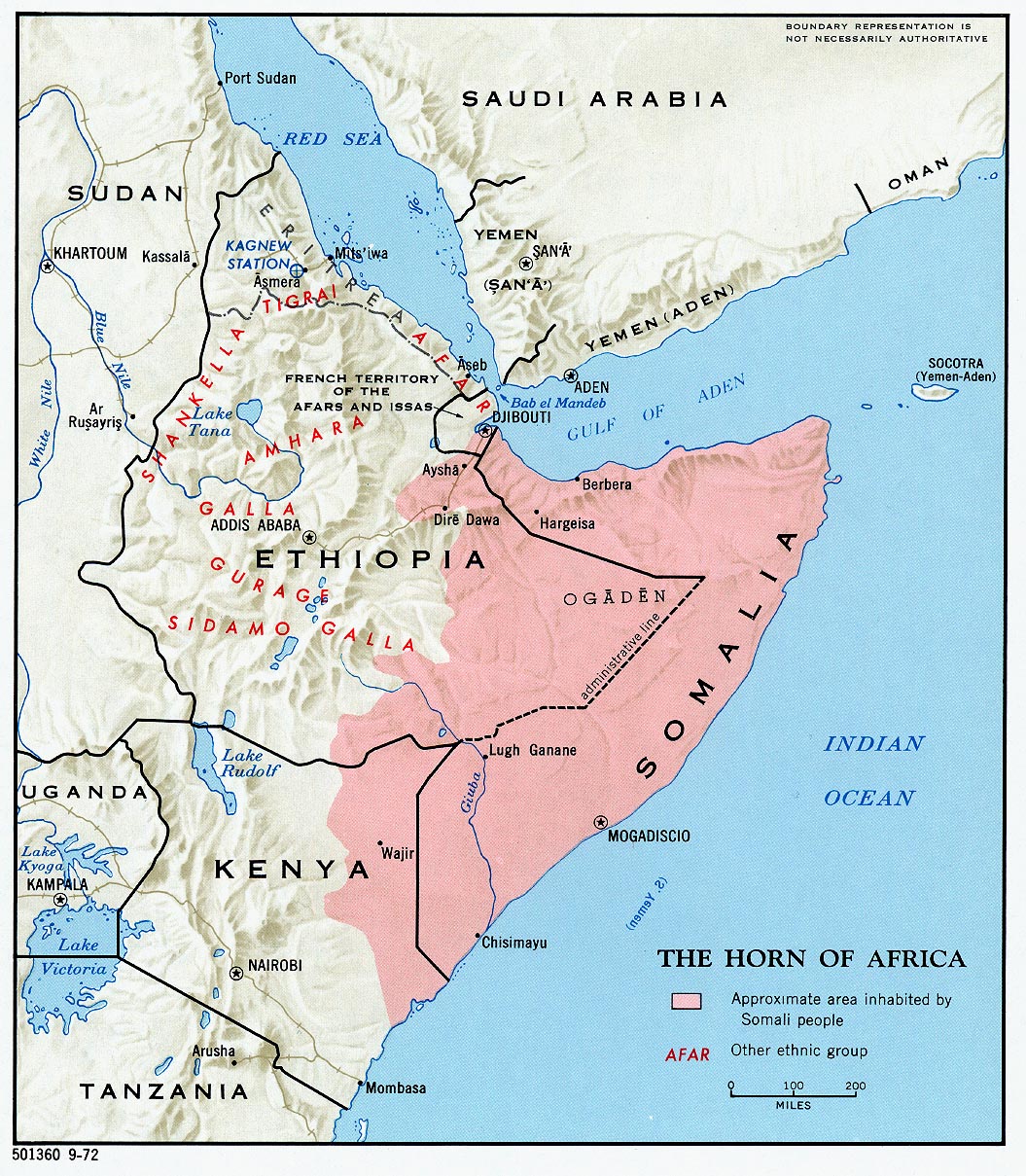
The ONLF mostly recruits from the Ogaden subclan, which constitutes roughly half of the regional population.[10] Some maps generally label the area or, in some instances, the entire Somali Region with "Ogadēn".[10][11][12][13] However, many other Somali clans and sub-clans reside in the area, and animosity between the pro-ONLF Ogadenis and other Somalis in the area remains very deeply rooted.

The Ethiopian government has exploited these rivalries by arming local Somali militias to fight the ONLF.[10] Yet, the ONLF also claims ownership of other clan territories and uses the word "Ogadenia," igniting clan hegemony accusations from other Somali clans.

Yet, some Darod Somali clan community members have complained that other Somali clans are getting over-represented in the regional government. [14] Writer Mohamed Mohamud Abdi states that the territory has been under occupation since the Scramble for Africa, and that the inhabitants have been unable to choose their own name for the land.[15]

[edit] Border issues

The nomadic lifestyle of Somali people have led to their occupation of disproportionally larger territory than other ethnicities in the Horn of Africa who have more population than Somalis, especially the neighboring Oromos. Small and big conflicts have occurred between Somalis, Oromos and Afars in the tense border regions for many centuries.

The Somali region of Ethiopia, often labeled Ogaden, also used to be known as Hararghe in the pre-1991 map of Ethiopia. The pre-1991 map showed Somalis occupying a large part of today's northeast Oromia while the post-1991 map shows the Ogaden region occupying Oromia's pre-1991 Bale region.

Ogaden nationalists have also complained that Dire Dawa city part of the Somali state and various towns including Maeso, Bardoda, Baabili, Fanyaanbiiro, Jinacsani and other regions were incorporated into Oromia during the transition period by the Oromo Peoples' Democratic Organization (OPDO). [16] Some Oromo liberation fighters believe a large chunk of Ogaden's territory belongs to them. [17][18] [19]

In February 2009, 300 people were killed and over 100,000 people displaced during a conflict outside the border town of Moyale between an Oromo clan and a Somali clan. [20]

[edit] Effects on Ethiopia and the Somali Civil War

Main article: War in Somalia (2006–2009)

ONLF rebels

On November 28, 2006, the ONLF threatened that it would not allow Ethiopian troops to stage into Somalia from their territories.[21]

On December 23, the ONLF claimed to have attacked an Ethiopian column near Baraajisale heading to Somalia, destroying 4 of 20 vehicles, inflicting casualties and driving the convoy back.[22] But no independent sources confirmed the attack.

On January 10, 2007, ONLF condemned Ethiopia's entry into the War in Somalia (2006-present), stating that Melez Zenawi's invasion of Somalia demonstrates that his government has been an active participant in the Somali conflict with a clear agenda aimed at undermining the Somali sovereignty.[23] However the Somalia government thanked the Ethiopian government for its assistance in Mogadishu.

On January 15, ONLF rebels attacked Ethiopian soldiers in Kebri Dahar, Gerbo, and Fiq. Five Ethiopian soldiers and one ONLF rebel have been reported killed.[24]

According to the Chicago Tribune, "As of 2007, human-rights groups and media reports accuse Ethiopia -- a key partner in Washington's battle against terrorism in the volatile Horn of Africa -- of burning villages, pushing nomads off their lands and choking off food supplies in a harsh new campaign of collective punishment against a restive ethnic Somali population in the Ogaden, a vast wilderness of rocks and thorns bordering chaotic Somalia".[25]

However the United Nations said the reports of aid blockade were completely wrong. The United Nations' WFP said it "does not consider the government is blockading the Somali region" and said that distributions of WFP food are under way in all vital regions. Yet, the UN also said that military operations in the area have restricted commercial trade and the movement of aid, which could lead to a humanitarian crisis.[26].

A tightly restricted and monitor tour by western journalist in the embattled region on the invitation of the regional administration reported on more alleged crimes by the Ethiopian government. A report by a Newsweek reporter detailed how Ethiopian military troops stormed a village southeast of Degahabur, accused the villagers of sympathise with the ONLF, then razing the village and torturing and murdering many of the inhabitants.[27].

[edit] Abole Raid, subsequent conflict

Main articles: Abole raid and 2007 Ogaden conflict

On April 24, 2007, members of the ONLF attacked a Chinese-run oil field in Abole, Somali Region, killing approximately 65 Ethiopians and 9 Chinese nationals.[28] According to Inter Press Service, all persons killed by the ONLF were civilians. [29][30] The ONLF claimed it had "completely destroyed" the oilfield.[23]

Most of the Ethiopians killed in the attack were daily laborers, guards and other support staff. Some members of the Ethiopian security officials were also killed during the surprise attack however those killed by the ONLF included 30 civilians, the ONLF attack was perpetuated as the ONLF has a policy of not allowing the Ethiopian government to extract resources as this will not be shared with the impoverished and suppressed population of the Ogaden, the Ogaden is largely a marginalized region as rebels have battled successive governments claiming discrimination and most recently crimes against humanity this was backed by a human rights watch report into alleged abuses.[31]

It was the most deadly single attack by the ONLF.[32] On April 27, Ethiopian government spokesperson reported that ONLF rebels had detonated a "grenade," killing one person who was attending a funeral of family member killed during the prior attack.[33]

Shortly after the attack, the Ethiopian Army launched a military crackdown in Ogaden. The latest action of this crackdown resulted in the death of foreign relations chief Mohammed Sirad at the town of Danan as he met with other ONLF members.[34] Reportedly this has led to the ONLF splitting into two factions, with one group allied to current ONLF chairman Mohammed Omar Osman, and the other led by senior leader Abdiwali Hussein Gas, who appointed Salahudin Ma'ow as the new ONLF chairman and declared that he will "bring Mohammed Omar Osman to court".[35]

[edit] Somali deaths

In May 2007, a grenade attack by ONLF rebels in the Somali region of Ethiopia claimed the lives of at least 11 Somalis. [36] During a national holiday ceremony held at the Ogaden town of Jijiga, the grenade thrown at the podium of the stadium also wounded Somali regional president Abdulahi Hassan Mohammed in the leg. Bereket Simon, an adviser to Prime Minister Meles, blamed the ONLF as well as Eritrea since it arms the ONLF. However the ONLF denied the accusations. [37] The bombing triggered a huge stampede in the stadium which led to the death of around six children.[38] Various Somalis, who are native to the Ogaden region, have always blamed the ONLF for killing their own people and assassinating Somali leaders.[39]

The war that began since the devastating attack by the ONLF in early 2007 has caused widespread humanitarian crisis. The violence has also hampered international locust-control efforts which observers say is a growing threat. [40]

[edit] Somaliland

The ONLF has been accused of targetting Somalis in the autonomous region of Somaliland. Some Somali civilians belonging to clans from Somaliland have been killed along the border and inside Ethiopia. [41] According to Sudan Tribune, the ONLF has been accused by local somalis of "laying mines, burning villages, attacking development projects and intimidating Somalis who do not support its cause." [42] The ONLF denies these accusations. According to the Somaliland Security Force, it has intercepted ONLF rebels who were crossing borders toward Ethiopia. It said around 1,200 ONLF recruits receiving training and graduating from Kalena and Addis Maskal training camps in Eritrea were captured as they tried to pass through Djibouti and Somaliland toward Ethiopia. [43]

[edit] Discovery of oil

As of 2009, no oil has been found in the Ogaden. The U.S. Energy Information Administration has been quoted as estimating that Ethiopia has 428,000 barrels of crude oil reserves. However, experts believe the real prize is the estimated 4 trillion cubic feet of natural gas.

This potential has drawn large companies such as Petronas from Malaysia and Lundin Petroleum, based in Sweden, to the inhospitable and nearly roadless Ogaden. [44]

[edit] Other ONLF attacks

An ONLF grenade attack on a cultural gathering in Jijiga killed four middle school students in May 28, 2007. In a separate attack, fifty civilians were injured, including the regional president Abdullahi Hassan, and three artists were killed in May 28, 2007 by the ONLF.[31]

  • An ONLF attack on the town of the Debeweyin woreda in the Korahe Zone also left ten civilians dead, including two schoolteachers and a pregnant woman.
  • Another attack on the town of Shilavo left five civilians dead. An ONLF-planted landmine near Aware in Dagahbour region exploded, killing three civilians traveling in automobile.

Yet another ONLF unit struck in the district of Lahelow near the Ethiopia-Somalia border, targeting members of the Isma'il Gum'adle sub-clan, twelve of whom were slain.[31] Regional security chief Abdi Mohammed Omar asserted that over a two months period, some 200 civilians had been killed by the ONLF.[45]

Ethiopia has been recently accused of human rights abuses. But Ethiopia says there is a double standard on terrorism since the ONLF group has killed many Ethiopians and Western nations have not condemned the killings.[46] Bashir is a family member of the founder of the Ogaden National Liberation Front and Ethiopia has accused him of financing and recruiting for the ONLF. Ethiopia points to another case of Western based Somali suicide bomber Shirwa Ahmed, who lived in Minnesota before going back to Somalia and killing Somali civilians at government and UN facilities. [47]

Ethiopia has been fighting alongside Western government against terrorists, including al Qaeda. But many Ethiopians says terrorists targeting Africans are not being condemned by the West. The ONLF has been accused of killing hundreds of civilians, but the biggest single act has been the killing of 74 Ethiopians and Chinese workers in 2007. [31][48]

[edit] Notes and references
^ As of March 2009. "Ethiopia ONLF rebels 'seize town'". BBC.com. BBC News. 2009-03-09. http://news.bbc.co.uk/2/hi/africa/7932972.stm. Retrieved 2009-03-09.

^ As of January 2009, the Ethiopian government claims that "the ONLF currently has no armed force in the state while its political existence is facing a great danger."

"Senior ONLF leader killed". Walta Information Center. 2009-01-21. http://www.waltainfo.com/index.php?option=com_content&task=view&id=6366&Itemid=52. Retrieved 2009-03-09.
^ "Collective Punishment: War Crimes and crimes against Humanity in the Ogaden area of Ethiopia's Somali Regional State" (pdf),
Human Rights Watch Report (2008), p. 27
^ Ethiopia: Crackdown in East Punishes Civilians (Human Rights Watch, 4-7-2007)
^ ETHIOPIA: Ogaden Crackdown Carries High Cost
^ Addis Ababa government uses significantly more money into Ogaden for roads and other services than it receives in taxes
^ Alliance for Freedom and Democracy (2006-05-22).
"Statement announcing the formation of the Alliance for Freedom and Democracy".
Press release. http://www.ethioindex.com/pressreleases/AFDpressrelease.htm. Retrieved 2007-04-26.
^ [1] Archived for subscribers only
^ Ogaden National Liberation Front (2006-08-12). "O.N.L.F Statement On Ethiopian Occupation Of Somalia". Press release. http://www.onlf.org/pressAug122006.htm. Retrieved 2007-01-08.
^ a b c Blair, David (2007-10-09). "Ethiopia's 'secret war' forces thousands to flee" (HTML). Telegraph.co.uk. Telegraph Media Group. http://www.telegraph.co.uk/news/main.jhtml?xml=/news/2007/10/09/wethiop109.xml. Retrieved 2007-10-30. "The rebels recruit most of their fighters from the Ogaden clan, who account for about half of the region's population. But the authorities are exploiting bitter clan rivalries and arming local militias to fight the ONLF."
^ Hertslet, Edward (1909). "The map of Africa by treaty". Harrison and Sons. http://memory.loc.gov/cgi-bin/query/r?ammem/gmd:@field(NUMBER+@band(g8200m+gct00004)). Retrieved 2007-10-30.
^ "The Horn of Africa" (JPEG). Central Intelligence Agency. September 1972. http://www.lib.utexas.edu/maps/africa/horn_of_africa_rel_1972.jpg. Retrieved 2007-10-30.
^ "Irish charity worker is kidnapped" (HTML). BBC News. BBC. 2006-09-20. http://news.bbc.co.uk/2/hi/uk_news/northern_ireland/5365250.stm. Retrieved 2007-10-30.
^ "The Perils of the EPRDF Politics Towards the Somali Region", an open letter dated 7 May 2005, signed by "Elders and Intellectuals of the Somali Regional State", published on the Wardheer News website (accessed 5 June 2009)
^ Mohamed Mohamud Abdi, A History of the Ogaden Struggle for Self-Determination. (United Kingdom: Lightning Source Uk, 2007).
^ Somalis: You "ain't" seen nothing yet, Wardheer News website
^ Oromo claim of Ogaden
^ Current Official map of Oromia and Ogaden
^ Ogaden claim of Oromia
^ Thousands flee Ethiopia clashes (BBC News website)
^ "Ogaden rebels to resist Ethiopian army if it attacks Somali-statement". Sudan Tribune. 2006-11-28. http://www.sudantribune.com/spip.php?article18952. Retrieved 2007-04-26.
^ "Ogaden rebels destroy Ethiopian military convoy en route to Somalia". Sudan Tribune. 2006-12-24. http://www.sudantribune.com/spip.php?article19437. Retrieved 2007-04-26.
^ a b Ogaden National Liberation Front (2007-04-24). "ONLF Statement On Military Operatio Against Illegal Oil Facility In Ogaden". Press release. http://www.onlf.org/pressAug062006.htm. Retrieved 2007-04-26.
^ "ONLF rebels attack Ethiopian soldiers in 3 towns". Garowe Online. 2007-01-15. http://www.garoweonline.com/stories/publish/article_7109.shtml. Retrieved 2007-04-26.
^ Fallout from war on terror hits Ethiopia - Civil Rights - chicagotribune.com
^ UN says there are no government aid blockades
^ Newsweek, January 22, 2008
^ "Ethiopian Rebels Kill 70 at Chinese-Run Oil Field". The New York Times. 2007-04-24. http://www.nytimes.com/2007/04/24/world/africa/24cnd-ethiopia.html?hp. Retrieved 2007-04-24.
^ ONLF attack 74 civilians in Ogaden
^ April 2007 attack killed at least 70 Chinese and Ethiopian civilians
^ a b c d Dr. J. Peter Pham, "Regional dimensions of the human rights and Humanitarian situation in the 'Ogaden', Somalia, and beyond": Testimony before the United States House of Representatives Committee on Foreign Affairs, Subcommittee on Africa and Global Health, October 2, 2007 (accessed 5 June 2009)
^ ONLF massacre detailed
^ "Ethiopian rebels attack family mourning victim of earlier rebel assault,", Associated Press, April 27, 2007
^ "Senior ONLF leader Killed" (accessed 27 January 2009)
^ "Ethiopia: Ogaden's ONLF breaks into two factions", Jimma Times, 3 March 2009 (accessed 9 March 2009)
^ United States House of Representatives Detail report on some of the killings of civilians by ONLF
^ "Rebel throws grenade during ceremony, injuring Ethiopian regional leader", AP wirestory 28 May 2007
^ Six children killed in the rebel attack
^ Ogaden natives blame ONLF for deaths
^ locust control efforts hampered by violence in Ogaden
^ Somaliland ONLF
^ ONLF: Laying mines, burning villages
^ Eritrea Providing Military Training For Hundreds Of ONLF Fighters
^ Paul Salopek, "Deadly battle for quixotic prize Vague promise of finding oil drives violence in Ethiopia", 5 August 2007
^ "Silence essential in Ogaden", News 24 website, 29 January 2008 (accessed 5 June 2009)
^ ONLF and "Terrorism double standards", statement by the Ethiopian Ministry of Foreign Affairs
^ The making of a Minnesota suicide bomber
^ Terrorist Group ONLF massacred 74 in Ogaden

The Rest @ Wikipeida
abstract art Pictures, Images and Photos