THis Great article in Wikipedia is being challgned for its lack on neutrality, which means it will soon be altered or dropped form the record - therefore - I will post it here for the record before it changes or disappears -Shimron IssacharThe ONLF was founded in
1984 by a group of six people:
Abdirahman Mahdi, the Chairman of the
Western Somali Liberation Movement Youth Union, Mohamed Ismail Omar of the
Western Somali Liberation Front (WSLF),
Sheikh Ibrahim Abdalla Mohamed (WSLF), Abdi Ibrahim Ghehleh (WSLF-Trade Union), Abdirahman Yusuf Magan (WSLF) and Abdullahi Muhumed Sa'di (WSLF). The ONLF is currently led by Chairman
Mohammed Omar Osman, who was elected to the post at the 1998 national convention.
The ONLF fought against the
Derg, the military dictatorship of
Mengistu Haile Mariam, but was not allied to the
Tigrayan People's Liberation Front (TPLF), the guerrilla movement led by Ethiopia's current prime minister,
Meles Zenawi.
[4]ONLF was formed after the defeat of Somalia in the
1977 Ogaden War. ONLF systematically recruited WSLF members and replaced WSLF in the Ogaden as Somalian support for the WSLF dwindled and finally ended in the late 1980s. By
1993 ONLF fully consolidated its position among ethnic Somalis in Ogaden. After the Mengistu regime fell, the ONLF joined the government but then left it when the Meles government launched its crackdown against the group in 1993 for advocating substantial autonomy or independence, both of which were permitted under Ethiopia's new constitution.
[5]The ONLF announced elections in December
1992 for the Somali District Five in Ethiopia, and won 80% of the seats of the local parliament. ONLF nominated the candidates for the district's presidency and vice-presidency and the Executive body and the parliament elected them in a majority vote. ONLF elected officials ruled the territory until the end of the charter period. Afterwards, the Ethiopian government pushed for a constitution since the former was a transitional period. In addition to ONLF there were/are other parties including the SPDP, which eventually won more seats and became politically dominant. The Ethiopian government was then accused by ONLF of suppressing its members, while ONLF was accused of killing other Somali politicians and elders.
The ONLF continues to operate in the Ogaden as of 2006
[update]. The Ethiopian military has stepped up its actions against ONLF following the organizations stated that it would attack the Malaysian oil company
Petronas, which plans to extract oil from the
Ogaden Basin. Even though there are some developments including a new university in the Somali state region, new schools, hospital and Somali language television programs, full development has been restrained in the area because of the fighting between ONLF and government forces. Because of the nomadic nature of the natives and to the ONLF insurgency, the Ethiopian government is said to spend very large share of its budget for the infrastructure development of the Ogaden region although it gets proportionally very low tax revenue from the locals.
[6]In
2005 Ethiopia proposed peace talks with ONLF. ONLF accepted on the condition that talks be held in a neutral country and with the presence of a neutral arbiter from the international community, but the talks broke down due to Ethiopia's insistence that the two parties meet directly in a location in or around the Horn of Africa. ONLF became a part of the
Alliance for Freedom and Democracy on
May 22,
2006 but the alliance has not achieved any progress since its creation.
[7]On
12 August 2006, 13 members of the ONLF were killed and several commanders were claimed captured as they crossed into Ethiopia from Somalia.
[8] The ONLF repudiated this claim, stating that it was intended to reassure prospective oil prospecting companies from Malaysia and China that Ethiopia is in control of the Ogaden territory.
[9]ONLF rebels practicting
Salah, Muslim daily prayers
[
edit] Ogadenia confusion
The ONLF mostly recruits from the
Ogaden subclan, which constitutes roughly half of the regional population.
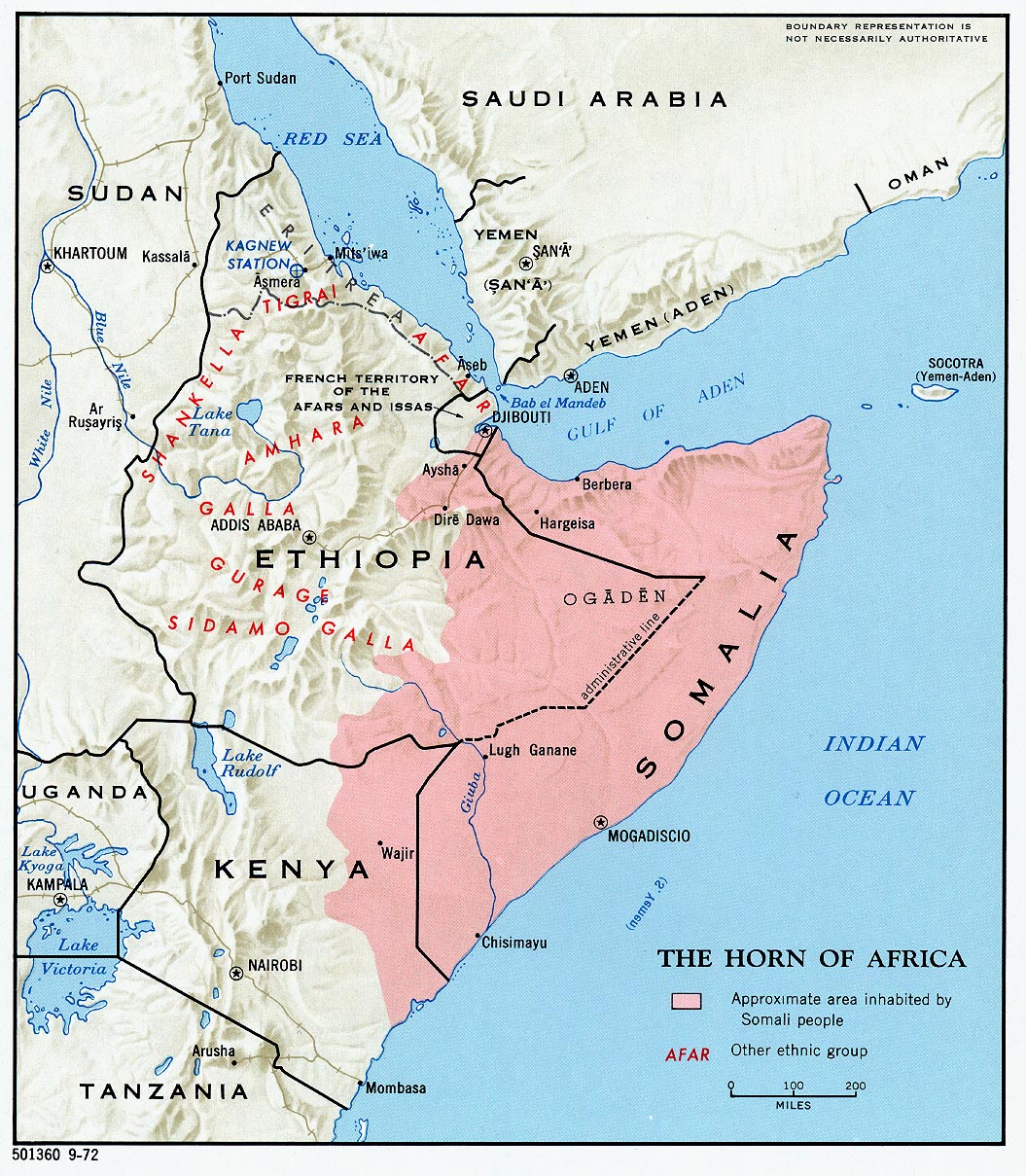
[10] Some maps generally label the area or, in some instances, the entire
Somali Region with "Ogadēn".
[10][11][12][13] However, many other Somali clans and sub-clans reside in the area, and animosity between the pro-ONLF Ogadenis and other Somalis in the area remains very deeply rooted.
The Ethiopian government has exploited these rivalries by arming local Somali militias to fight the ONLF.
[10] Yet, the ONLF also claims ownership of other clan territories and uses the word "Ogadenia," igniting clan hegemony accusations from other Somali clans.
Yet, some
Darod Somali clan community members have complained that other Somali clans are getting over-represented in the regional government.
[14] Writer
Mohamed Mohamud Abdi states that the territory has been under occupation since the
Scramble for Africa, and that the inhabitants have been unable to choose their own name for the land.
[15][
edit] Border issues
The nomadic lifestyle of Somali people have led to their occupation of disproportionally larger territory than other ethnicities in the Horn of Africa who have more population than Somalis, especially the neighboring
Oromos. Small and big conflicts have occurred between Somalis, Oromos and Afars in the tense border regions for many centuries.
The Somali region of Ethiopia, often labeled Ogaden, also used to be known as
Hararghe in the pre-1991 map of
Ethiopia. The pre-1991 map showed Somalis occupying a large part of today's northeast Oromia while the post-1991 map shows the Ogaden region occupying Oromia's pre-1991 Bale region.
Ogaden nationalists have also complained that
Dire Dawa city part of the Somali state and various towns including Maeso, Bardoda, Baabili, Fanyaanbiiro, Jinacsani and other regions were incorporated into Oromia during the transition period by the
Oromo Peoples' Democratic Organization (OPDO).
[16] Some Oromo liberation fighters believe a large chunk of Ogaden's territory belongs to them.
[17][18] [19]In February 2009, 300 people were killed and over 100,000 people displaced during a conflict outside the border town of
Moyale between an Oromo clan and a Somali clan.
[20][
edit] Effects on Ethiopia and the Somali Civil War
Main article:
War in Somalia (2006–2009)ONLF rebels
On
November 28,
2006, the ONLF threatened that it would not allow Ethiopian troops to stage into Somalia from their territories.
[21]On
December 23, the ONLF claimed to have attacked an Ethiopian column near
Baraajisale heading to Somalia, destroying 4 of 20 vehicles, inflicting casualties and driving the convoy back.
[22] But no independent sources confirmed the attack.
On
January 10,
2007, ONLF condemned Ethiopia's entry into the
War in Somalia (2006-present), stating that Melez Zenawi's invasion of Somalia demonstrates that his government has been an active participant in the Somali conflict with a clear agenda aimed at undermining the Somali sovereignty.
[23] However the Somalia government thanked the Ethiopian government for its assistance in Mogadishu.
On
January 15, ONLF rebels attacked Ethiopian soldiers in
Kebri Dahar,
Gerbo, and
Fiq. Five Ethiopian soldiers and one ONLF rebel have been reported killed.
[24]According to the
Chicago Tribune, "As of 2007, human-rights groups and media reports accuse Ethiopia -- a key partner in Washington's battle against terrorism in the volatile Horn of Africa -- of burning villages, pushing nomads off their lands and choking off food supplies in a harsh new campaign of collective punishment against a restive ethnic Somali population in the Ogaden, a vast wilderness of rocks and thorns bordering chaotic Somalia".
[25]However the
United Nations said the reports of aid blockade were completely wrong. The United Nations' WFP said it "does not consider the government is blockading the Somali region" and said that distributions of WFP food are under way in all vital regions. Yet, the UN also said that military operations in the area have restricted commercial trade and the movement of aid, which could lead to a humanitarian crisis.
[26].
A tightly restricted and monitor tour by western journalist in the embattled region on the invitation of the regional administration reported on more alleged crimes by the Ethiopian government. A report by a Newsweek reporter detailed how Ethiopian military troops stormed a village southeast of Degahabur, accused the villagers of sympathise with the ONLF, then razing the village and torturing and murdering many of the inhabitants.
[27].
[
edit] Abole Raid, subsequent conflict
Main articles:
Abole raid and
2007 Ogaden conflictOn
April 24,
2007, members of the ONLF attacked a Chinese-run oil field in
Abole,
Somali Region, killing approximately 65 Ethiopians and 9 Chinese nationals.
[28] According to
Inter Press Service, all persons killed by the ONLF were civilians.
[29][30] The ONLF claimed it had "completely destroyed" the oilfield.
[23]Most of the Ethiopians killed in the attack were daily laborers, guards and other support staff. Some members of the Ethiopian security officials were also killed during the surprise attack however those killed by the ONLF included 30 civilians, the ONLF attack was perpetuated as the ONLF has a policy of not allowing the Ethiopian government to extract resources as this will not be shared with the impoverished and suppressed population of the Ogaden, the Ogaden is largely a marginalized region as rebels have battled successive governments claiming discrimination and most recently crimes against humanity this was backed by a human rights watch report into alleged abuses.
[31]It was the most deadly single attack by the ONLF.
[32] On
April 27, Ethiopian government spokesperson reported that ONLF rebels had detonated a "grenade," killing one person who was attending a funeral of family member killed during the prior attack.
[33]Shortly after the attack, the
Ethiopian Army launched a
military crackdown in Ogaden. The latest action of this crackdown resulted in the death of foreign relations chief
Mohammed Sirad at the town of
Danan as he met with other ONLF members.
[34] Reportedly this has led to the ONLF splitting into two factions, with one group allied to current ONLF chairman Mohammed Omar Osman, and the other led by senior leader
Abdiwali Hussein Gas, who appointed
Salahudin Ma'ow as the new ONLF chairman and declared that he will "bring Mohammed Omar Osman to court".
[35][
edit] Somali deaths
In May 2007, a grenade attack by ONLF rebels in the Somali region of Ethiopia claimed the lives of at least 11 Somalis.
[36] During a national holiday ceremony held at the Ogaden town of
Jijiga, the grenade thrown at the podium of the stadium also wounded Somali regional president
Abdulahi Hassan Mohammed in the leg.
Bereket Simon, an adviser to Prime Minister Meles, blamed the ONLF as well as Eritrea since it arms the ONLF. However the ONLF denied the accusations.
[37] The bombing triggered a huge stampede in the stadium which led to the death of around six children.
[38] Various Somalis, who are native to the Ogaden region, have always blamed the ONLF for killing their own people and assassinating Somali leaders.
[39]The war that began since the devastating attack by the ONLF in early 2007 has caused widespread humanitarian crisis. The violence has also hampered international locust-control efforts which observers say is a growing threat.
[40][
edit] Somaliland
The ONLF has been accused of targetting Somalis in the autonomous region of
Somaliland. Some Somali civilians belonging to clans from Somaliland have been killed along the border and inside Ethiopia.
[41] According to Sudan Tribune, the ONLF has been accused by local somalis of "laying mines, burning villages, attacking development projects and intimidating Somalis who do not support its cause."
[42] The ONLF denies these accusations. According to the Somaliland Security Force, it has intercepted ONLF rebels who were crossing borders toward Ethiopia. It said around 1,200 ONLF recruits receiving training and graduating from Kalena and Addis Maskal training camps in Eritrea were captured as they tried to pass through Djibouti and Somaliland toward Ethiopia.
[43][
edit] Discovery of oil
As of 2009, no oil has been found in the Ogaden. The U.S. Energy Information Administration has been quoted as estimating that Ethiopia has 428,000 barrels of crude oil reserves. However, experts believe the real prize is the estimated 4 trillion cubic feet of
natural gas.
This potential has drawn large companies such as Petronas from Malaysia and
Lundin Petroleum, based in Sweden, to the inhospitable and nearly roadless Ogaden.
[44][
edit] Other ONLF attacks
An ONLF grenade attack on a cultural gathering in Jijiga killed four middle school students in May 28, 2007. In a separate attack, fifty civilians were injured, including the regional president Abdullahi Hassan, and three artists were killed in May 28, 2007 by the ONLF.
[31]- An ONLF attack on the town of the Debeweyin woreda in the Korahe Zone also left ten civilians dead, including two schoolteachers and a pregnant woman.
- Another attack on the town of Shilavo left five civilians dead. An ONLF-planted landmine near Aware in Dagahbour region exploded, killing three civilians traveling in automobile.
Yet another ONLF unit struck in the district of Lahelow near the Ethiopia-Somalia border, targeting members of the Isma'il Gum'adle sub-clan, twelve of whom were slain.
[31] Regional security chief
Abdi Mohammed Omar asserted that over a two months period, some 200 civilians had been killed by the ONLF.
[45]Ethiopia has been recently accused of human rights abuses. But Ethiopia says there is a double standard on terrorism since the ONLF group has killed many Ethiopians and Western nations have not condemned the killings.
[46] Bashir is a family member of the founder of the Ogaden National Liberation Front and Ethiopia has accused him of financing and recruiting for the ONLF. Ethiopia points to another case of Western based Somali suicide bomber Shirwa Ahmed, who lived in Minnesota before going back to Somalia and killing Somali civilians at government and UN facilities.
[47]Ethiopia has been fighting alongside Western government against terrorists, including al Qaeda. But many Ethiopians says terrorists targeting Africans are not being condemned by the West. The ONLF has been accused of killing hundreds of civilians, but the biggest single act has been the killing of 74 Ethiopians and Chinese workers in 2007.
[31][48][
edit] Notes and references
^ As of March 2009. "
Ethiopia ONLF rebels 'seize town'". BBC.com. BBC News. 2009-03-09.
http://news.bbc.co.uk/2/hi/africa/7932972.stm. Retrieved 2009-03-09.
^ As of January 2009, the Ethiopian government claims that "the ONLF currently has no armed force in the state while its political existence is facing a great danger."
"
Senior ONLF leader killed". Walta Information Center. 2009-01-21.
http://www.waltainfo.com/index.php?option=com_content&task=view&id=6366&Itemid=52. Retrieved 2009-03-09.
^ "Collective Punishment: War Crimes and crimes against Humanity in the Ogaden area of Ethiopia's Somali Regional State" (pdf),
Human Rights Watch Report (2008), p. 27
^ Ethiopia: Crackdown in East Punishes Civilians (Human Rights Watch, 4-7-2007)^ ETHIOPIA: Ogaden Crackdown Carries High Cost^ Addis Ababa government uses significantly more money into Ogaden for roads and other services than it receives in taxes^ Alliance for Freedom and Democracy (2006-05-22).
"
Statement announcing the formation of the Alliance for Freedom and Democracy".
Press release.
http://www.ethioindex.com/pressreleases/AFDpressrelease.htm. Retrieved 2007-04-26.
^ [1] Archived for subscribers only
^ Ogaden National Liberation Front (2006-08-12). "
O.N.L.F Statement On Ethiopian Occupation Of Somalia". Press release.
http://www.onlf.org/pressAug122006.htm. Retrieved 2007-01-08.
^
a b c Blair, David (2007-10-09). "
Ethiopia's 'secret war' forces thousands to flee" (HTML). Telegraph.co.uk. Telegraph Media Group.
http://www.telegraph.co.uk/news/main.jhtml?xml=/news/2007/10/09/wethiop109.xml. Retrieved 2007-10-30. "The rebels recruit most of their fighters from the Ogaden clan, who account for about half of the region's population. But the authorities are exploiting bitter clan rivalries and arming local militias to fight the ONLF."
^ Hertslet, Edward (1909). "
The map of Africa by treaty". Harrison and Sons.
http://memory.loc.gov/cgi-bin/query/r?ammem/gmd:@field(NUMBER+@band(g8200m+gct00004)). Retrieved 2007-10-30.
^ "
The Horn of Africa" (JPEG).
Central Intelligence Agency. September 1972.
http://www.lib.utexas.edu/maps/africa/horn_of_africa_rel_1972.jpg. Retrieved 2007-10-30.
^ "
Irish charity worker is kidnapped" (HTML). BBC News.
BBC. 2006-09-20.
http://news.bbc.co.uk/2/hi/uk_news/northern_ireland/5365250.stm. Retrieved 2007-10-30.
^ "The Perils of the EPRDF Politics Towards the Somali Region", an open letter dated 7 May 2005, signed by "Elders and Intellectuals of the Somali Regional State", published on the Wardheer News website (accessed 5 June 2009)
^ Mohamed Mohamud Abdi, A History of the Ogaden Struggle for Self-Determination. (United Kingdom: Lightning Source Uk, 2007).
^ Somalis: You "ain't" seen nothing yet, Wardheer News website
^ Oromo claim of Ogaden^ Current Official map of Oromia and Ogaden^ Ogaden claim of Oromia^ Thousands flee Ethiopia clashes (BBC News website)
^ "
Ogaden rebels to resist Ethiopian army if it attacks Somali-statement".
Sudan Tribune. 2006-11-28.
http://www.sudantribune.com/spip.php?article18952. Retrieved 2007-04-26.
^ "
Ogaden rebels destroy Ethiopian military convoy en route to Somalia".
Sudan Tribune. 2006-12-24.
http://www.sudantribune.com/spip.php?article19437. Retrieved 2007-04-26.
^
a b Ogaden National Liberation Front (
2007-
04-24). "
ONLF Statement On Military Operatio Against Illegal Oil Facility In Ogaden". Press release.
http://www.onlf.org/pressAug062006.htm. Retrieved 2007-04-26.
^ "
ONLF rebels attack Ethiopian soldiers in 3 towns".
Garowe Online. 2007-01-15.
http://www.garoweonline.com/stories/publish/article_7109.shtml. Retrieved 2007-04-26.
^ Fallout from war on terror hits Ethiopia - Civil Rights - chicagotribune.com^ UN says there are no government aid blockades^ Newsweek, January 22, 2008
^ "
Ethiopian Rebels Kill 70 at Chinese-Run Oil Field".
The New York Times. 2007-04-24.
http://www.nytimes.com/2007/04/24/world/africa/24cnd-ethiopia.html?hp. Retrieved 2007-04-24.
^ ONLF attack 74 civilians in Ogaden^ April 2007 attack killed at least 70 Chinese and Ethiopian civilians^
a b c d Dr. J. Peter Pham,
"Regional dimensions of the human rights and Humanitarian situation in the 'Ogaden', Somalia, and beyond": Testimony before the United States House of Representatives Committee on Foreign Affairs, Subcommittee on Africa and Global Health, October 2, 2007 (accessed 5 June 2009)
^ ONLF massacre detailed^ "Ethiopian rebels attack family mourning victim of earlier rebel assault,",
Associated Press,
April 27,
2007^ "Senior ONLF leader Killed" (accessed 27 January 2009)
^ "Ethiopia: Ogaden's ONLF breaks into two factions", Jimma Times, 3 March 2009 (accessed 9 March 2009)
^ United States House of Representatives Detail report on some of the killings of civilians by ONLF^ "Rebel throws grenade during ceremony, injuring Ethiopian regional leader", AP wirestory 28 May 2007
^ Six children killed in the rebel attack^ Ogaden natives blame ONLF for deaths^ locust control efforts hampered by violence in Ogaden^ Somaliland ONLF^ ONLF: Laying mines, burning villages^ Eritrea Providing Military Training For Hundreds Of ONLF Fighters^ Paul Salopek,
"Deadly battle for quixotic prize Vague promise of finding oil drives violence in Ethiopia", 5 August 2007
^ "Silence essential in Ogaden", News 24 website, 29 January 2008 (accessed 5 June 2009)
^ ONLF and "Terrorism double standards", statement by the Ethiopian Ministry of Foreign Affairs
^ The making of a Minnesota suicide bomber^ Terrorist Group ONLF massacred 74 in OgadenThe Rest @
Wikipeida


 RSS Feed (xml)


 Posts
Posts